Robots with whiskers
The creation of robotic organs and tissues going ahead with encouraging speed in recent years, but the re-creation of the sense of touch continues to create difficulties. One of the solutions was inspired by the way the cats and mice navigate in space – with the help of their whiskers. The moustache for robots offer good opportunities for orientation, and are hardy and can function in low light or missing.
The robotic assist mustache, developed by scientists at Sheffield transmit vibrations to the base and thus can sense whether a surface is smooth or rough, and whether the path of the robot corner. The invention is equipped with small motors that allow the moustache to rub something. Whiskered robot can track moving objects without getting any Visual information that will make it very suitable for operations at the time of the fire.
Creation of electronic whiskers sensitive whiskers paves the way to better interaction of robots with their environment, says Popular Mechanics. The whiskers, as cats are, biological sensors, which nature has given in response to the need for orientation in darkness. They have the ability to perceive and the lightest air movements and help the cats to hunt at night or the insect to move in tight spaces.
The specialist in electrical engineering and computer science at the University of California, Bekrli, Ali Dzavej has created Robo-whiskers, which are an example for the development of technology, imitating biological organisms.
The electrons used thin moustache instead of hair follicles on nanomaterials, and replace the nerve endings with electronic instruments. To create the perfect e-moustache, Džavej and his team searched for Nanomaterials that are both lightweight and with high sensitivity. Carbon nanotubes provide mustache flexibility, while silver particles increase the sensitivity.
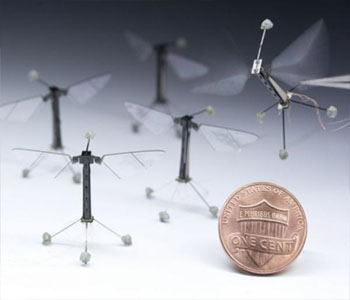
Scientists at Harvard University have created a miniature robot-insect, able to fly along the lines of their biological analogs. The development has taken 12 years of the team, led by Robert Wood, said the University website. The movement of each of the two wings of the RoboBee is managed by a separate electric motor that allows setting the direction and height.
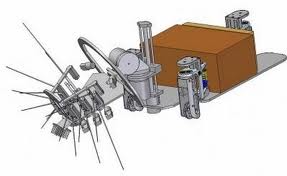
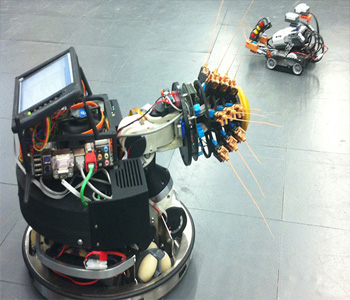
Robot Shrewbot represents the Etruscan shrew, which possesses an enviable moustache length. You replace the eyes in the darkness. The robot then yet last year you could have with their help to get around, to detect and bypass obstacles. Now, however, it is the most advanced, such as through your mustache can recreate in your own computer "brain" reasonably accurate map of the area surrounding it. A key role for the new capabilities of the robot plays the program tSLAM (tactile Simultaneous Localization and Mapping), which compiles a map of the surrounding area. And earlier, and now the robot has sensors 18-mustache, equipped with its own power supply and the sensors and mounted on the "glavenvata" of the machine. In moving forward the robot continuously moving his head, reminding of the different smells vdišvaŝo animal. In this way, the Shrewbot combines data from hundreds of thousands of sprikosnoveniâ, hatching a "tactile" map of the surrounding area.
The mouse pointer can be found in two blurred meshes of the mouse.
The aim of the project is to identify the biological targets of the target population and to identify the different types of urban areas (visually and comatose).
АМоuѕе is a matter of a few social problems - the monopoly, the censors, that is, the concept of the mallow.
Sometimes you have been dropped in a live mcpop. This mice have vibrations with a total of 3000 viruses per day. This is the immittance of the ceasefire of its militants, which are the mainstay of noca.
Trafficking in motor vehicles, AMouse is used to make the most of the vehicle. The subject can also be the same as ycvopaenia and vampaia in the audience, which use them.